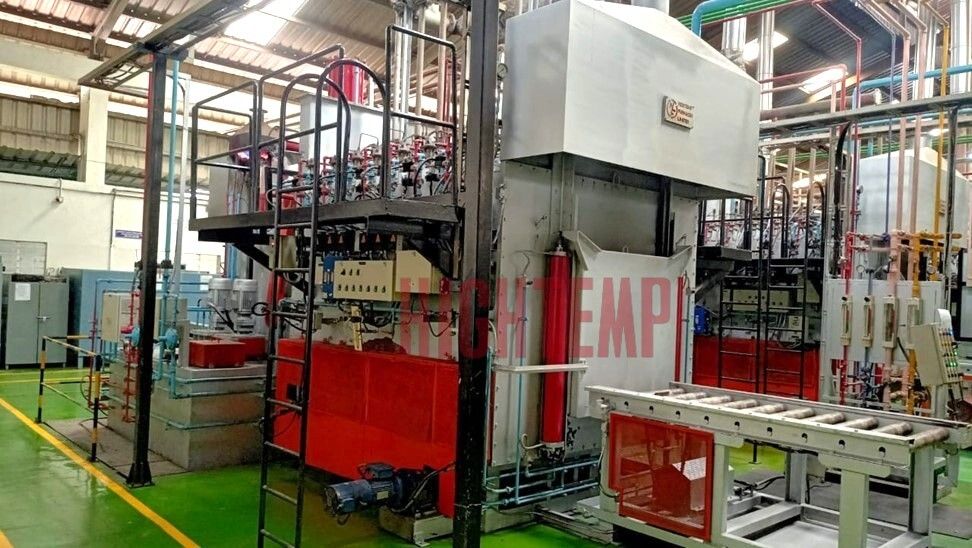
In modern manufacturing, heat treatment is not only about achieving hardness. Manufacturers also want:
- Faster production
- Consistent quality
- Lower energy consumption
- Easy automation
- Safer operations
Because of these needs, many industries are choosing Straight-Through Sealed Quench Furnaces. Industries such as automotive, bearings, fasteners, gears, and engineering components prefer this design because it improves production efficiency and reduces operating costs.
What Is Different in a Straight-Through Furnace?
In an In-Out Type Furnace, components are loaded and unloaded from the same side. This requires repeated forward and reverse movement during every cycle.
A Straight-Through Sealed Quench Furnace works differently. Components enter from one side and exit from the other side in a continuous flow.
This simple design change offers major advantages in:
- Production speed
- Automation
- Maintenance
- Energy efficiency
- Material handling
1. Higher Production Throughput
Straight-through furnaces support continuous production flow. Since components move in one direction:
- Loading and unloading become faster
- Material handling time is reduced
- Waiting time between batches is minimized
- Overall productivity increases
This helps manufacturers achieve higher daily output and better furnace utilization.
2. Better Heat Treatment Consistency
Straight-through furnaces provide better process stability because:
- Heat distribution is more uniform
- Furnace atmosphere is easier to control
- Quenching conditions remain stable
- Oxidation and decarburization risks are lower
This ensures repeatable and reliable heat treatment results, especially for precision automotive and engineering components.
3. Improved Plant Layout
The linear design fits easily into modern production lines. Benefits include:
- Better use of floor space
- Smooth material movement
- Easier conveyor integration
- Reduced congestion in loading areas
Compared to in-out furnaces, straight-through systems create a cleaner and more organized production setup.
4. Easier Automation
Straight-through furnaces are ideal for automated manufacturing. They can easily integrate with:
- Conveyors
- Robotic handling systems
- Automatic loading and unloading
- Smart monitoring systems
Reduced manual handling improves process consistency and supports Industry 4.0 manufacturing environments.
5. Lower Maintenance Requirements
In in-out furnaces, repeated back-and-forth movement increases wear on mechanical parts. Straight-through systems reduce mechanical stress because material movement is smoother and continuous. Advantages include:
- Less wear on handling systems
- Lower maintenance frequency
- Longer equipment life
- Reduced downtime
This improves overall operational reliability.
6. Better Energy Efficiency
Energy savings are a major advantage of straight-through furnaces. They improve thermal efficiency through:
- Continuous operation
- Reduced heat loss
- Stable furnace temperature
- Fewer door openings
Lower heat loss means lower fuel or electricity consumption, helping manufacturers reduce operating costs.
7. Improved Operator Safety
Straight-through furnaces reduce operator exposure to high-temperature areas. This helps:
- Minimize manual handling
- Reduce accident risks
- Improve workplace safety
- Lower chances of operational errors
Automation also contributes to safer furnace operation.
HIGHTEMP Furnaces Ltd provides advanced heat treatment furnace solutions designed for modern industrial applications, including sealed quench furnaces and continuous heat treatment systems built for high efficiency, reliability, and automation readiness.